

Contact
Contact us

SAFETY DEVICES

Safety is a fundamental aspect in the use of sectional overhead doors. This is why Novoferm provides mechanical and electrical safety devices designed to reduce the risk of contact with people, vehicles or obstacles and prevent possible damage. The safety systems offered are TÜV Nord certified and comply with the most stringent test requirements and regulations. Anti-lifting protection is also available, adding an extra layer of security against break-in attempts.

MECHANICAL SAFETY FUNCTIONS
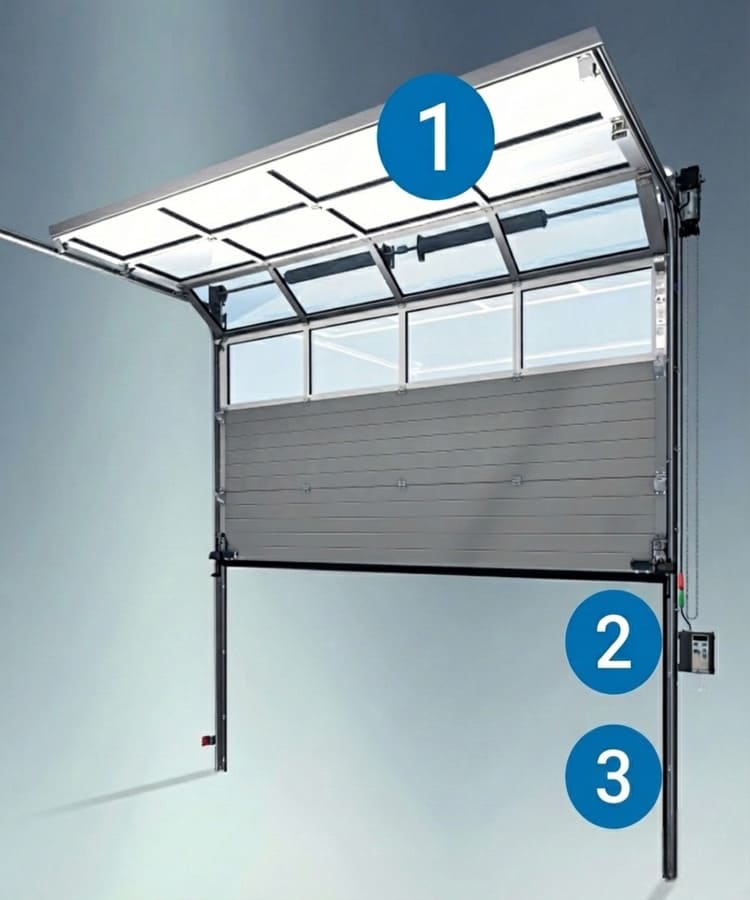
This diagram summarises the main standard safety features of the door and clarifies their role during handling. The aim is to guarantee controlled and stable operation, reducing the risks of component wear and tear and preventing potentially dangerous situations in the event of failure or tampering.

Specifically, the diagram highlights:

  1. Safety device against spring breakage: it intervenes if a spring breaks, blocking the balancing system and preventing the sash from losing control on descent.
  2. Safety device against rope breakage: in the event of a loose or broken rope, it activates the lock and/or stops the movement, preventing a sudden and uncontrolled descent.
  3. Anti-lifting protection: counters attempts at forced lifting from the outside, increasing security against tampering and burglary.

Together, these solutions form an effective security system: each component is designed to limit uncontrolled movements and help keep the door in safe operating condition even in the presence of malfunctions.
SAFETY DEVICE AGAINST SPRING BREAKAGE
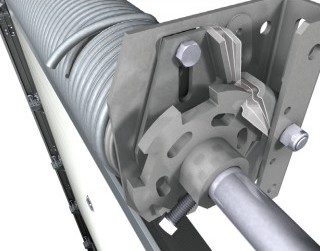
The European standard EN 13241 requires that the descent of a sectional door must always take place in a controlled manner. Therefore, manually operated doors require a device that locks the spring shaft in the event of breakage, preventing the door leaf from falling. In motorised doors, this function is generally guaranteed by the self-locking gearbox, making the device superfluous. However, with quick release, it is also necessary to install the spring break protection.

SAFETY DEVICE AGAINST BREAKING OF ROPES
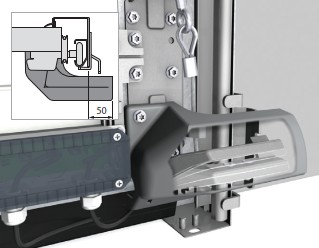
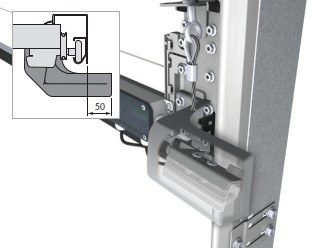
TÜV certification requires that the breaking load of both lifting ropes be at least six times the weight of a door panel. If the ropes do not meet this requirement, the door must be equipped with a safety device against rope breakage as standard. In the event of a breakage, the device comes into operation by pressing the pawls against the frames, thus preventing uncontrolled downward movement. The installation of this safety device requires 50 mm of additional space along the runner.

ANTI-RAISING PROTECTION
Sectional doors are suspended by flexible ropes which, when released, allow the door leaf to be raised. The locking device, developed for light electrically operated doors, prevents the ropes from being released, increasing protection against break-in attempts. Manually operated doors, on the other hand, are equipped with a spring-loaded mechanical sliding stop as standard. The installation of the locking device also requires an additional 50 mm of space along the sliding track during assembly.

ELECTROMECHANICAL SAFETY FUNCTIONS
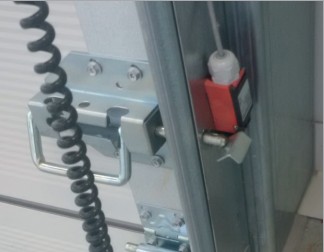
LOCK WITH MICROSWITCH
The deadbolt engages in the slide rail, physically preventing the door from opening. At the same time, the microswitch deactivates the drive function, preventing accidental commands or attempts at movement when the system is locked. This provides double protection, mechanical and electrical, reducing the risk of tampering from the outside.
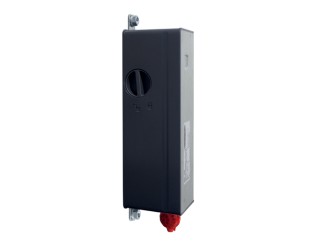
ELECTRONIC DOOR LOCKING DEVICE EDL 100
For industrial sectional doors equipped with the T100 control unit, the electronic locking device EDL 100 is available as an option. Installed on the outside of the sliding track, once activated it locks the door via a steel pin, preventing it from lifting upwards.
ELECTRONIC SECURITY DEVICES

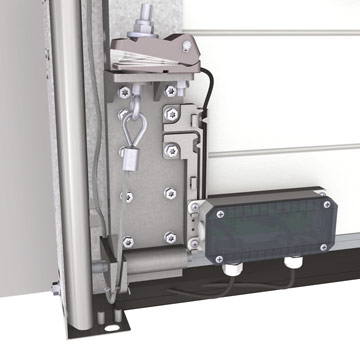
SAFETY DEVICE AGAINST LOOSING OF THE ROPES
This safety device, installed on both lifting ropes, immediately interrupts the power supply to the motor if one of the load-bearing ropes breaks or comes loose.

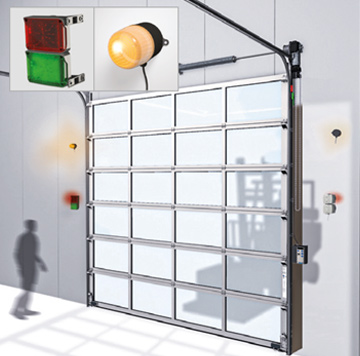
SIGNAL LIGHTS AND WARNING LIGHTS
Signal lights and flashing warning lights on both sides of the door increase safety: the flashing lights provide an advance warning before the door starts moving, while the signal lights regulate traffic, preventing collisions and damage to the door and goods. 

PHOTOELECTRIC BARRIER
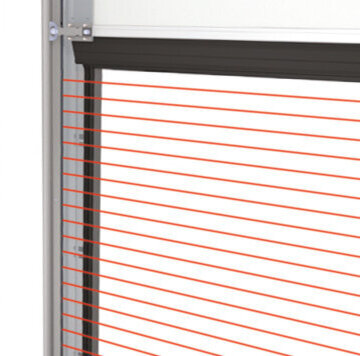
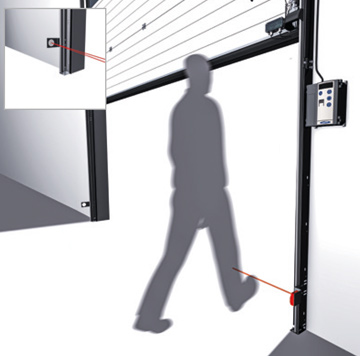
Industrial sectional doors can be optionally equipped with a photoelectric barrier. The system consists of a transmitter and receiver and is factory-installed inside the track system, with integrated, invisible wiring.

STANDARD SAFETY PHOTOCOAT
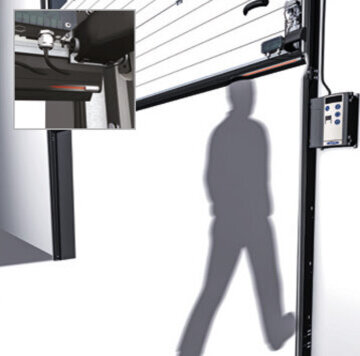
The obstacle detection system with transmitter and receiver is integrated in the rubber sealing profile of the door. If a person or object interrupts the signal, the door stops and automatically reverses. The rubber seal exerts a maximum contact pressure of 40 kg; should the goods being handled not be able to withstand this level of pressure, the use of a predictive safety edge is recommended.

PREDICTIVE SAFETY PHOTOCOAT
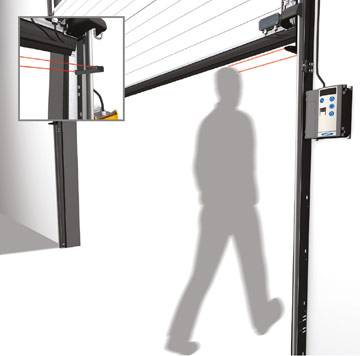
With this option, the obstacle detection device is positioned 8 cm before the bottom edge of the door. When the underside approaches an obstacle, the system sends a signal directly to the drive: the door stops and is immediately raised, minimising reaction time. The device operates without contact, avoiding collisions with people, goods or transport vehicles and contributing to safer handling.

STATIC SAFETY PHOTOCELL
If the pulse-controlled door is operated outside the operator's visual control, the safety photocell is mandatory. Two versions are available: transmitter + reflector or transmitter + receiver. The transmitter is mounted on the control-side rail and the reflector/receiver on the opposite rail; if the beam is interrupted, the motor stops and reverses. The receiver model is less sensitive to dust and moisture.